
Strategic Researcher Priorities
Explore Trauma NB’s five strategic research topics and two national collaboration studies. Select a topic to read the full research question, rationale, or study overview.
Off-road & emerging vehicles
Protective equipment use, injury severity and patient outcomes.
Alcohol & motor vehicle injuries
Blood alcohol concentration and outcomes following motor vehicle collisions.
Airway management after trauma
Intubation, sedation, analgesia and post-intubation hypotension.
Repeat major injury
Patient and injury factors associated with another major trauma admission.
Falls & independence
Fall risk, prevention and autonomy among older adults.
National collaborations
Two studies in collaboration with a national working group from the Trauma Association of Canada.
Validated trauma care indicators
A scoping review of measures used to assess adult trauma care quality.
Canadian trauma system indicators
A consensus study to identify core measures of trauma system performance.
Doing Research with Trauma NB
These are the steps and procedures for conducting research using data from Trauma NB.
Step #1 – Connecting with Trauma NB, Content Experts, and Support
Contact the Trauma NB’s Epidemiologist (Nicholas.MacLean@HorizonNB.ca) to discuss your project to ensure a similar project is not already on-going, that Trauma NB has the data you need, and to connect you to the appropriate support services and content experts.
Context Experts Consultations
Trauma NB will provide the relevant trauma content experts to consult with you on your project, be it clinical experts such as physicians, nurses, respiratory therapists, paramedics, injury prevention experts, data experts, methodological and research experts, and more.
Research and Library Support
You will also have access to Horizon Research Services and Horizon Library Services to provide additional support and guidance to you.
Step #2 – Draft Study Protocol
Complete a draft version of your study protocol including the following sections:
- Cover Page
- Abstract
- Introduction
- Literature Review
- Rationale
- Research Question
- Theoretical Framework
- Conceptual Framework
- Trauma NB
- About Trauma NB
- Trauma NB Registry
- Methods
- Study Design
- Population
- Recruitment
- Intention to apply for waiver of informed consent and inclusion of pediatric patients (Appendix B and C).
- Intervention (Exposure)
- Comparison
- Outcomes
- Data Analysis Plan
- Data Storage and Protection Plan
- Knowledge Translation Plan
- Budget
- Conflicts of Interest
- Limitations
- References
- Appendix A
- Codebook
- Appendix B
- Waiver of Informed Consent – Article 5.5A
- Appendix C
- Inclusion of Pediatric Patients – Articles 3.9, 3.10, 4.6
- Appendix D
- STROBE Checklist
- Appendix E
- Recruitment Materials
Step #3 – Prepare Ethics Application
Prepare ethics application through Horizon’s Research Services Human Research Ethics Board. Here are the documents you will need:
- Study Protocol
- Including version number and date.
- Your CV.
- TCPS-2 (Core 2022) Training Certificate
- Trauma NB Registry – Release of Information Request Form
- Trauma NB Data Dictionary
Step #4 – Submit Ethics
Create an account on the Horizon HREB portal here.
Make sure to include the following Trauma NB people on the application as co-investigators:
- Allison Chisholm – Allison.Chisholm@HorizonNB.ca
- Allison is the Trauma NB Registry Manager who will be extracting the data from the registry.
- Nicholas MacLean – Nicholas.MacLean@HorizonNB.ca
- Nicholas is the Trauma Epidemiologist who will be supporting you throughout the process and cleaning the data for your project.
- Possibly additional members depending on the project.
Step #5 – Receiving your Data
Once you receive ethics approval send the approval letter as a PDF to Trauma NB. Once received, Trauma NB will begin preparing your data. You will need to visit a Trauma NB office to receive your data. You will need to bring the laptop you will be using for the research with you so the data can be transferred to it. Individuals with a email address domain within Service New Brunswick (@HorizonNB.ca, @VitaliteNB.ca, @Medavie.ca, etc.) can receive the data by email.

Resources for Collaborative Research
Here are some resources to aid in the process of collaborating in research with Trauma NB.
Ongoing Research
Trauma NB not only has a mandate to increase research capacity, but is also actively engaged in conducting research. Here are some projects that Trauma NB currently has on the go:
-
Falls and Seriously Injured Patients in New Brunswick: A Nine-Year Registry Review.
-
Motor Vehicle Crashes and Seriously Injured Patients in New Brunswick
-
Post-intubation Analgesia and Sedation for Injured Patients in the Emergency Department: Introduction of an Education Intervention
-
Supporting Older Adults through Transitions in Care: How Patient Navigators Can Help
-
Older Adults Waiting for Transitions in Care in Hospital: Understanding the Journey
-
What is the utilization of the Emergency Departments in Horizon Health Network in New Brunswick by Residents who live in Special Care Homes?

Research
Click on the works below to access research published by members of Trauma NB:
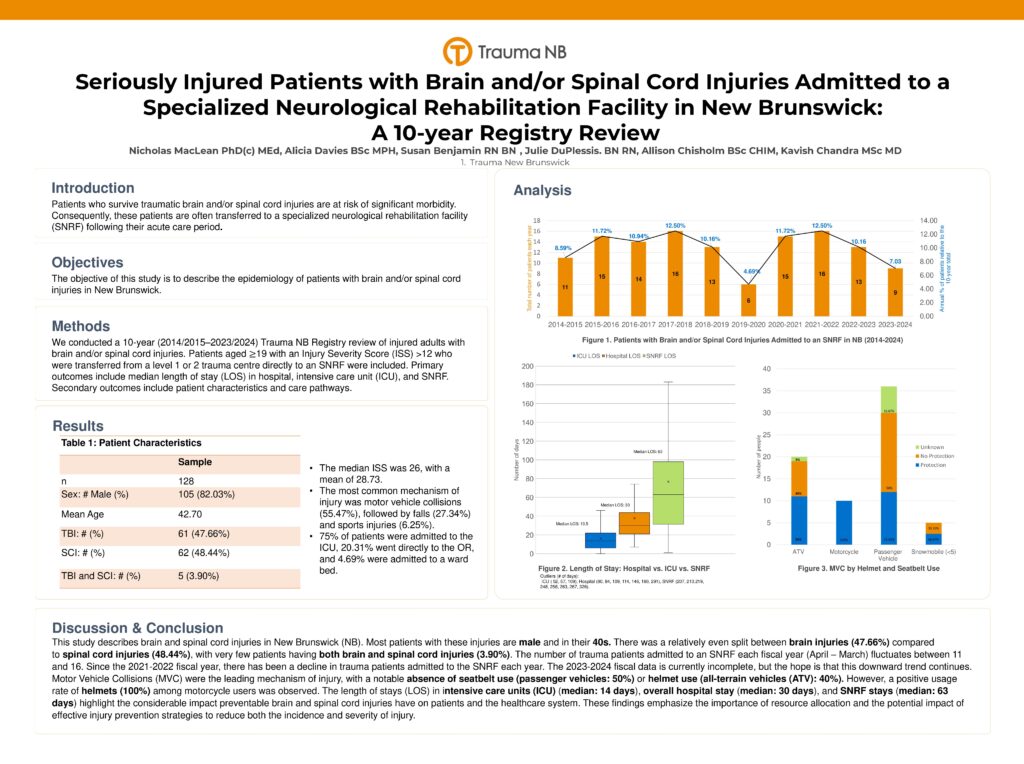
2025 TAC Conference Poster
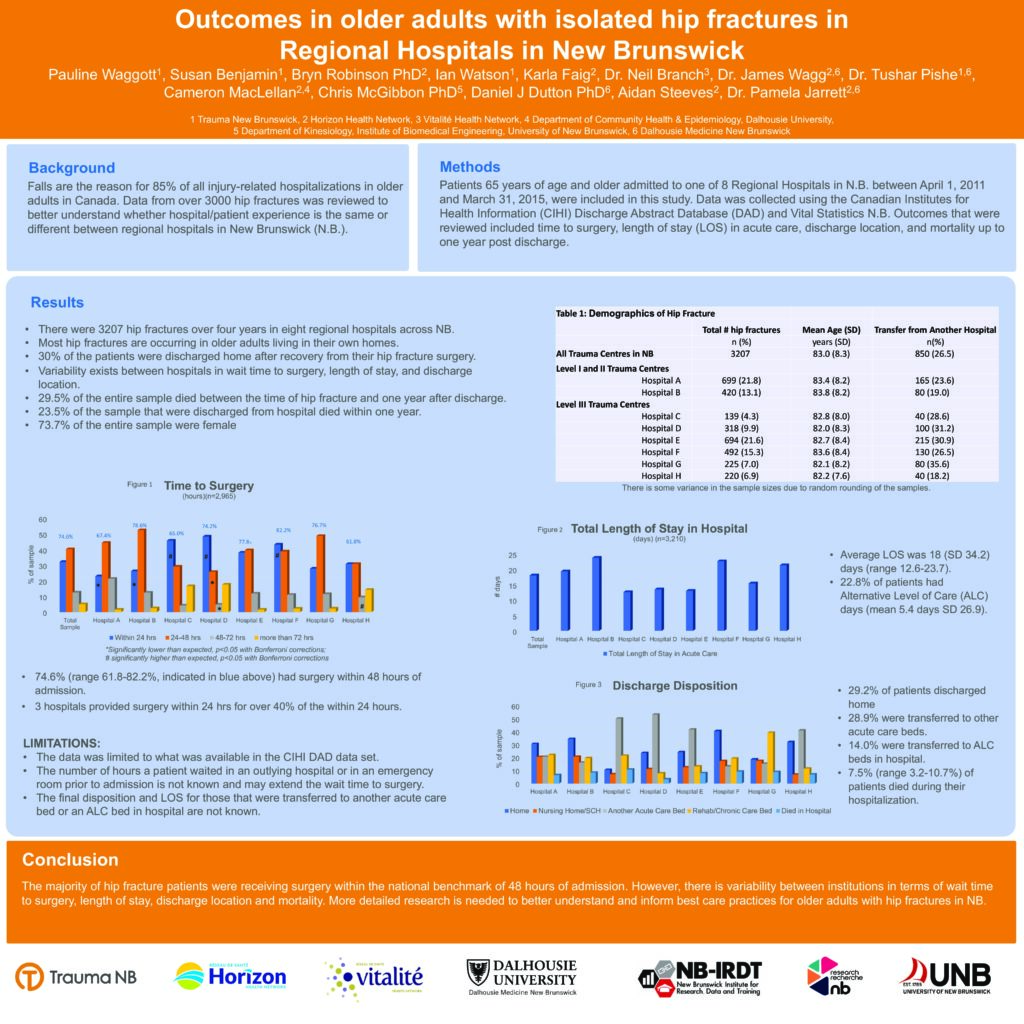
2024 TAC Conference Poster
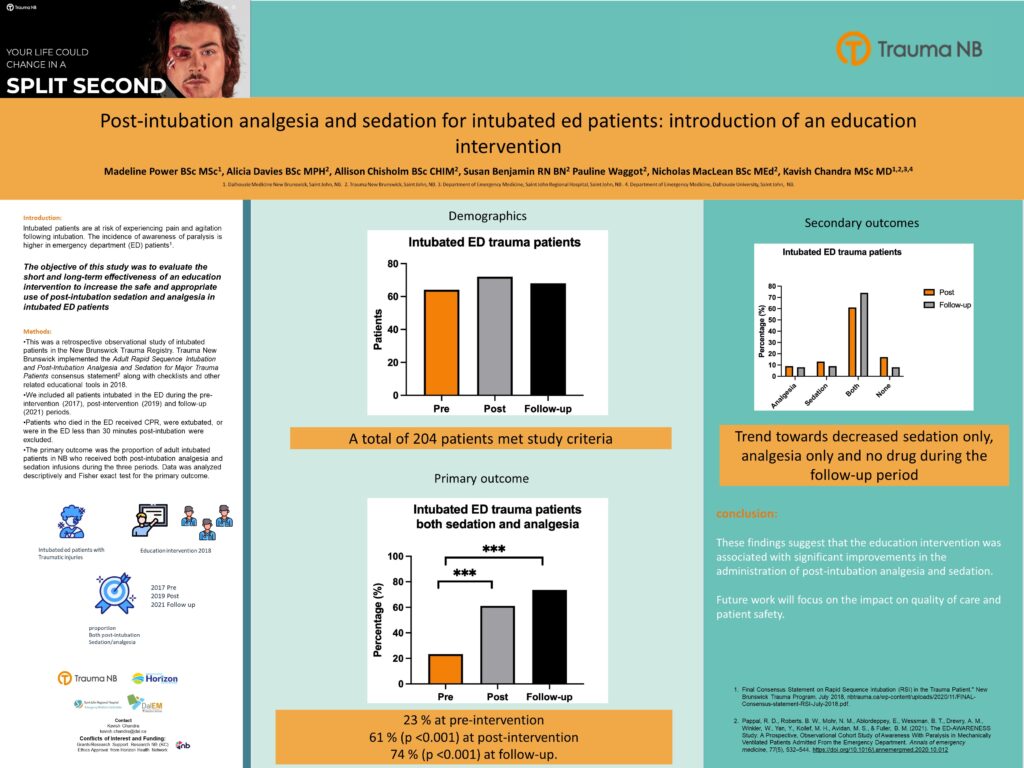
2024 NB Health Research Symposium Poster
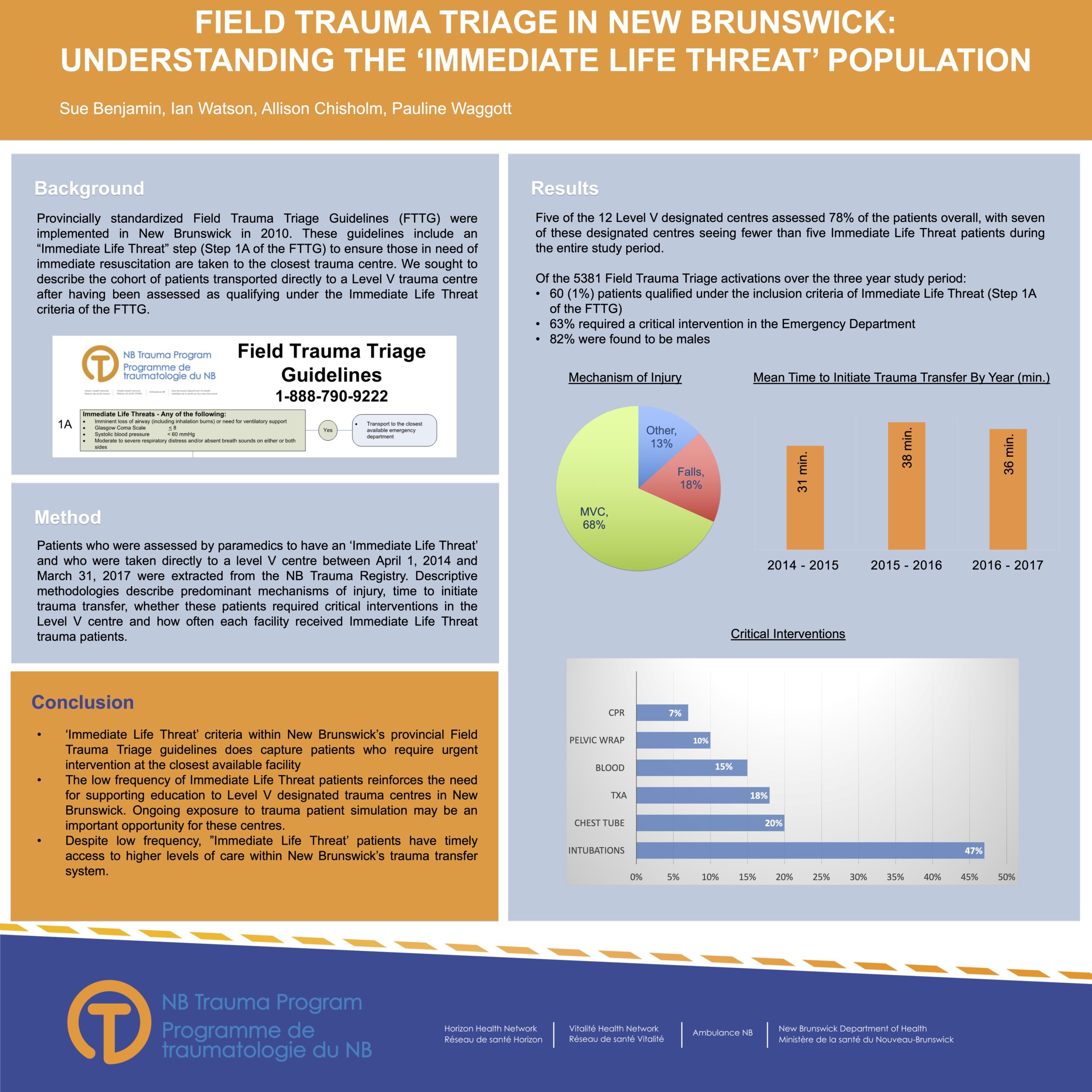
2019 TAC Conference Poster
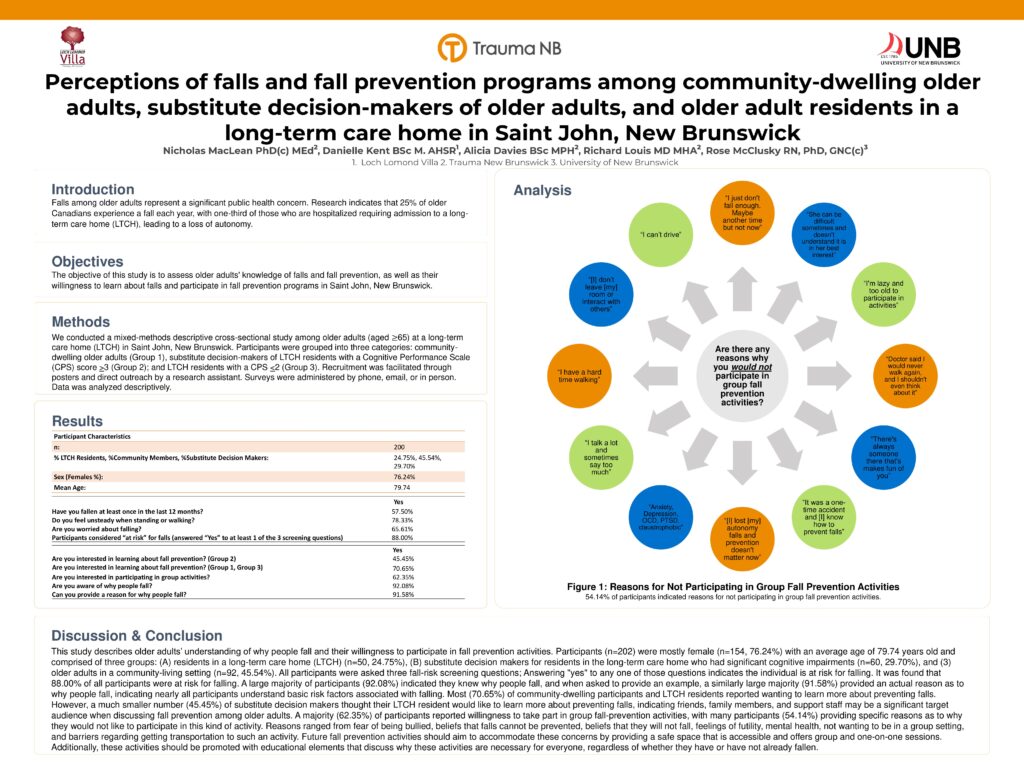
2025 TAC Conference Poster
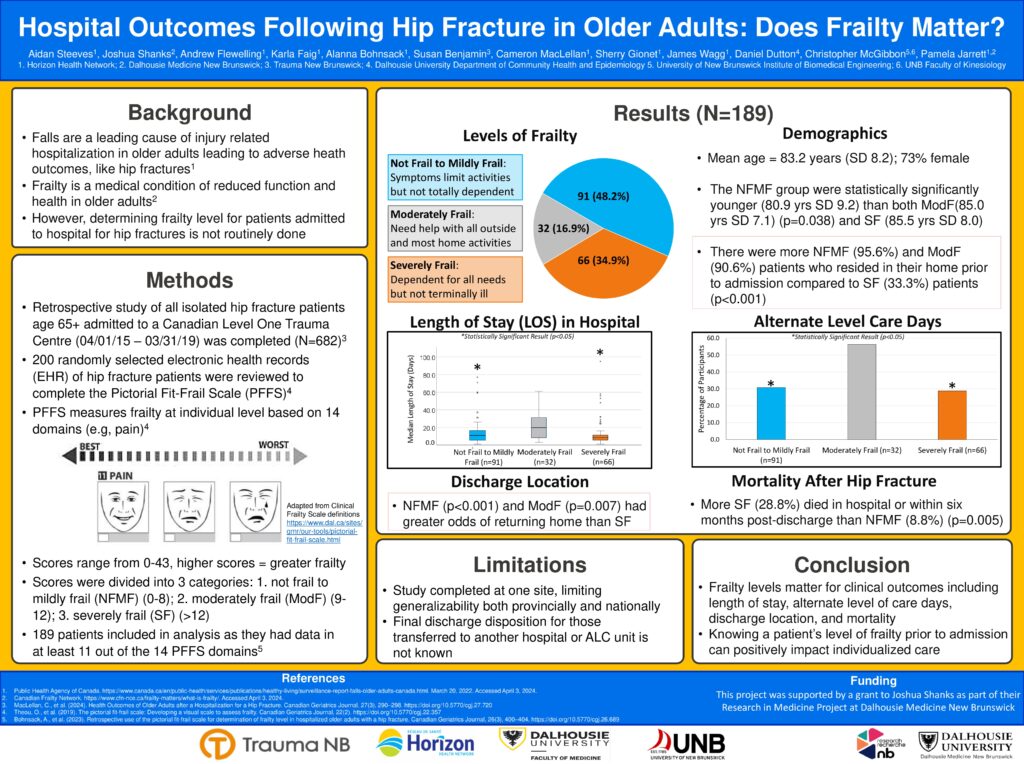
2024 British Geriatrics Society Autumn Meeting Poster
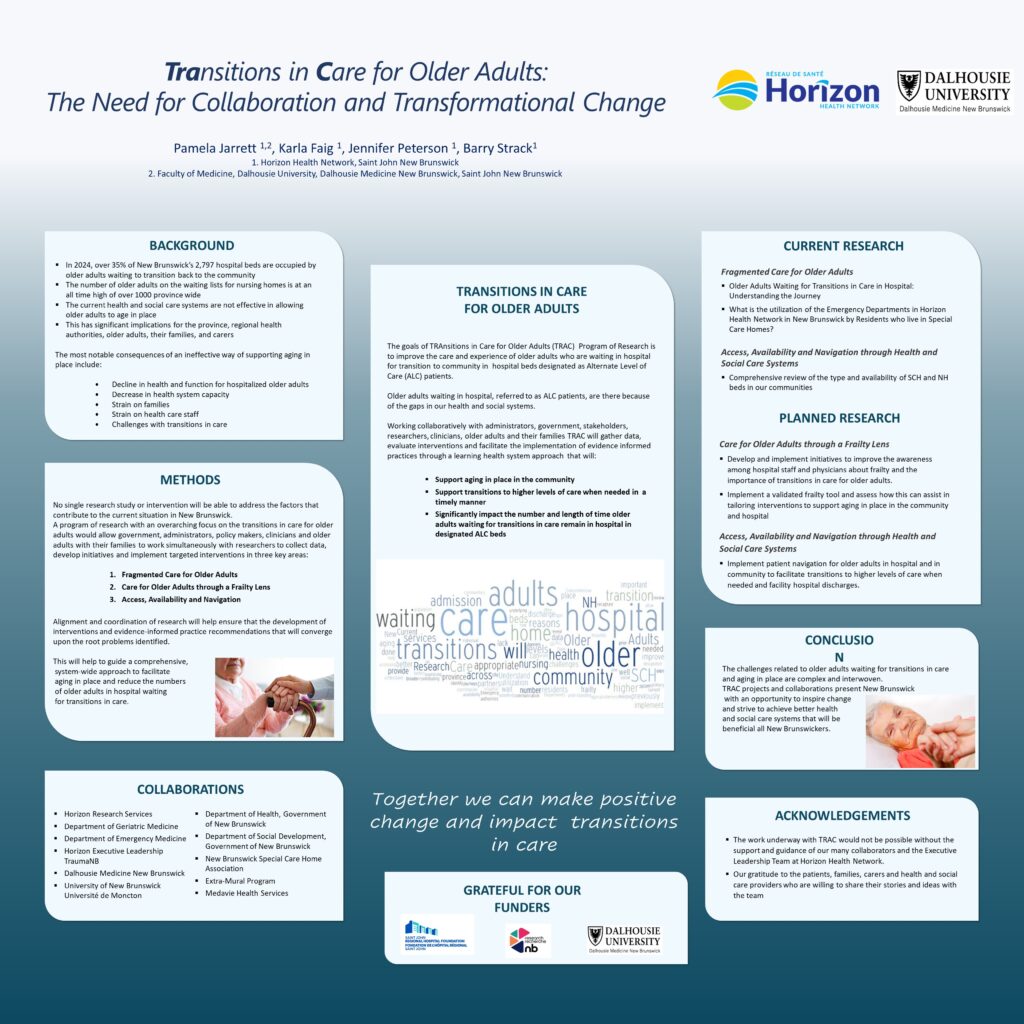
2024 NB Health Research Symposium Poster
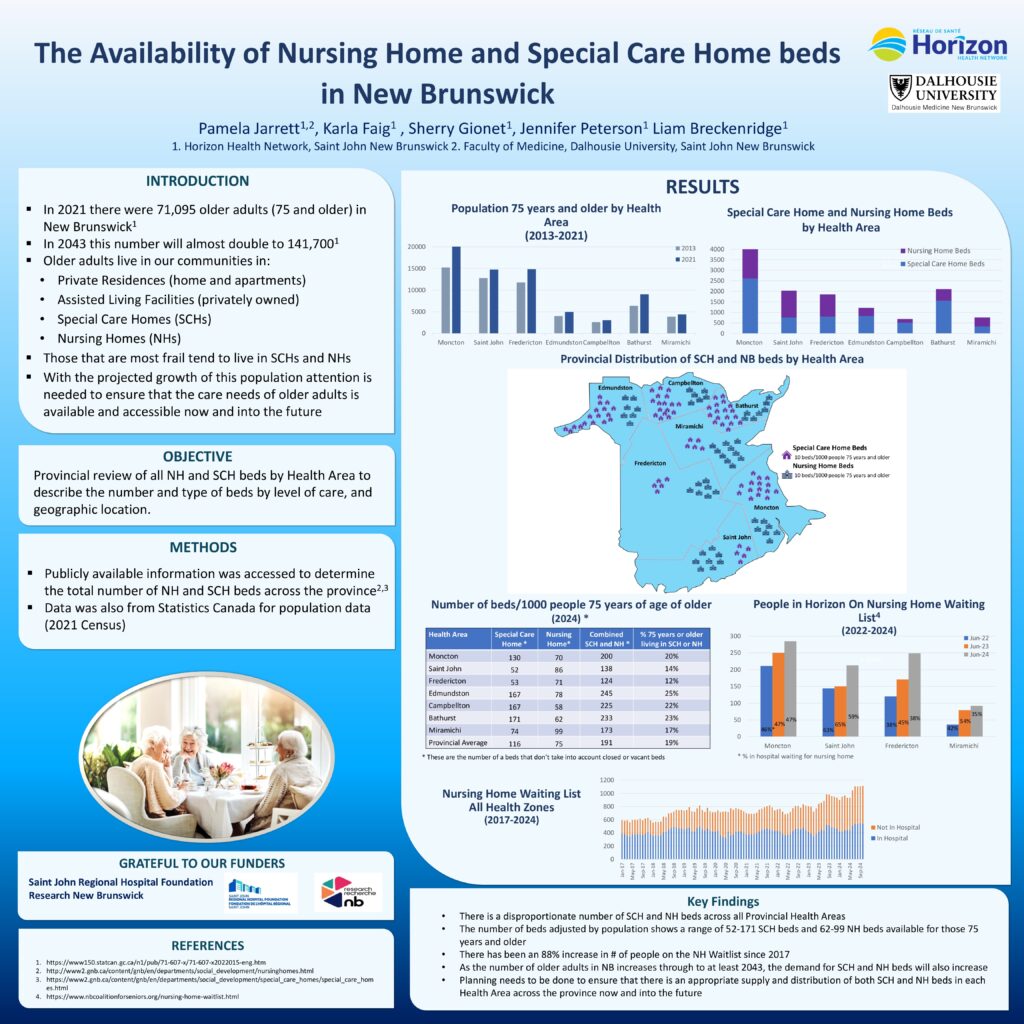
2024 NB Health Research Symposium Poster
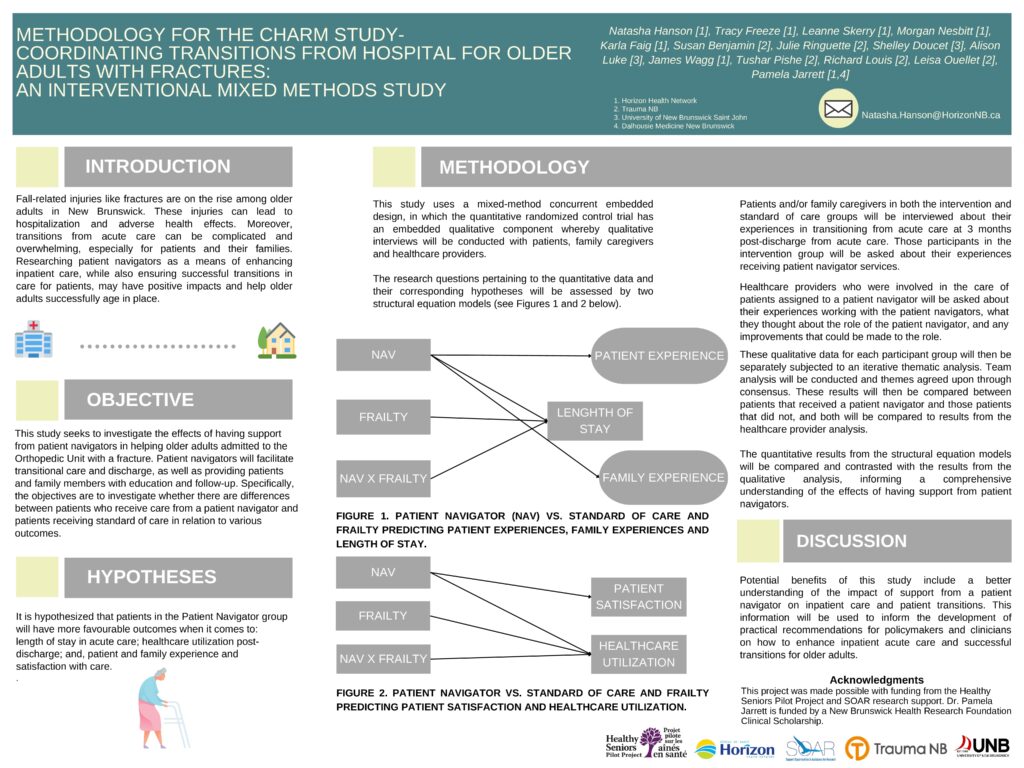
2024 Horizon Health Network Researching in Aging Conference Poster
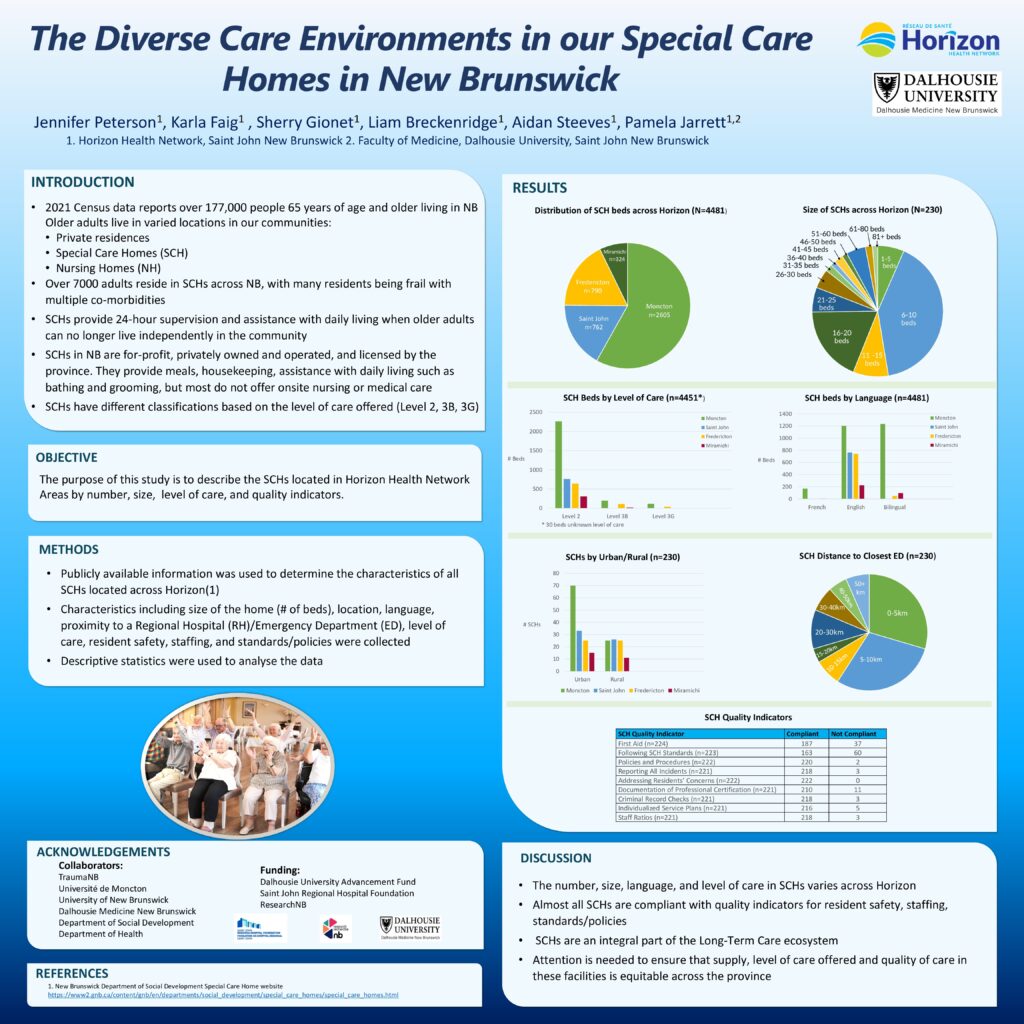
2024 NB Health Research Symposium Poster
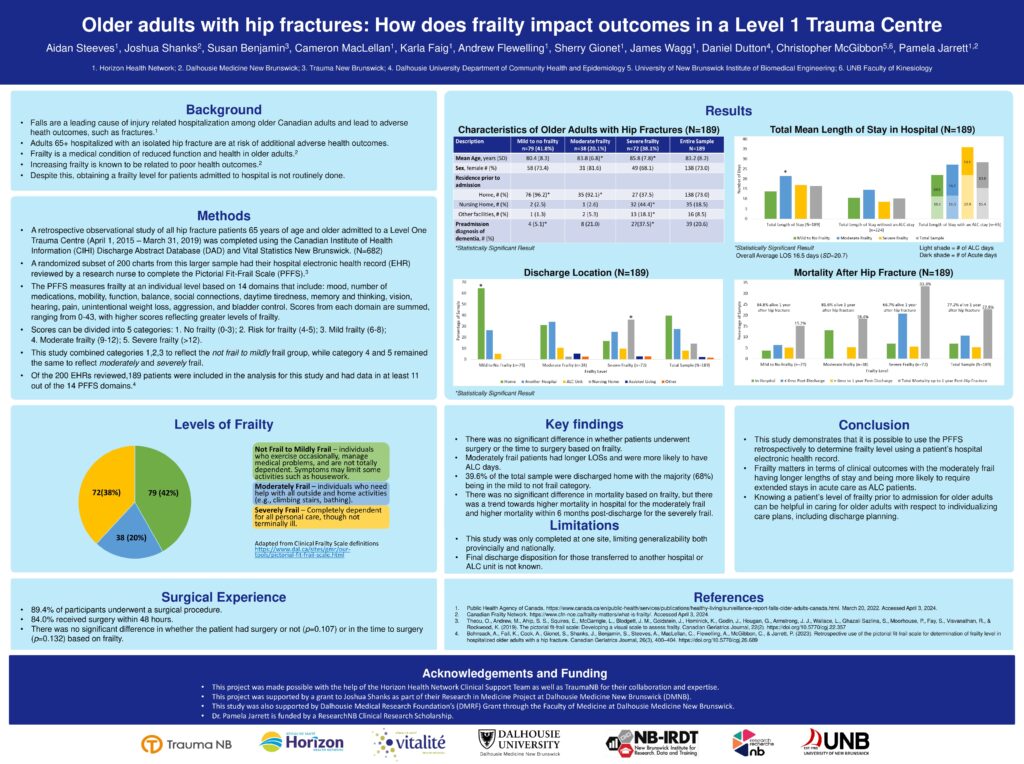
2024 TAC Conference Poster
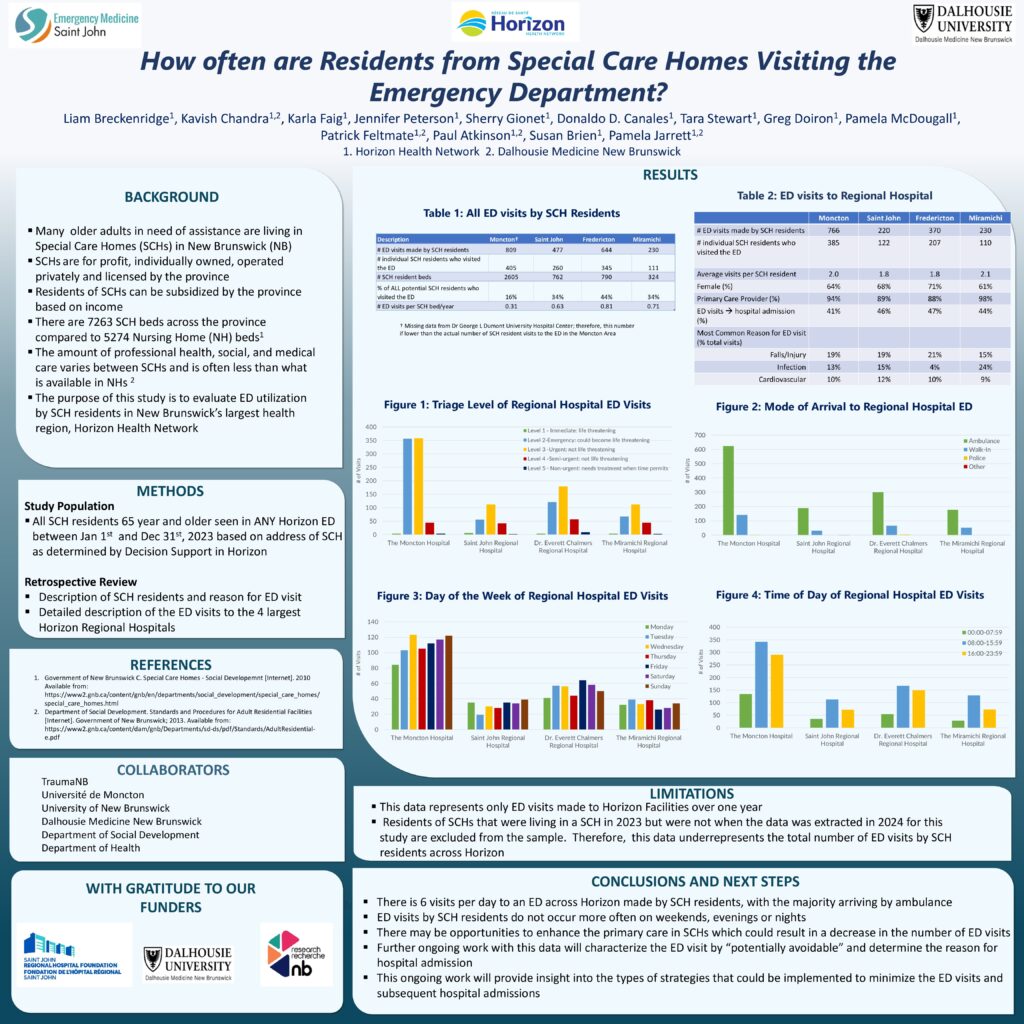
2024 NB Health Research Symposium Poster
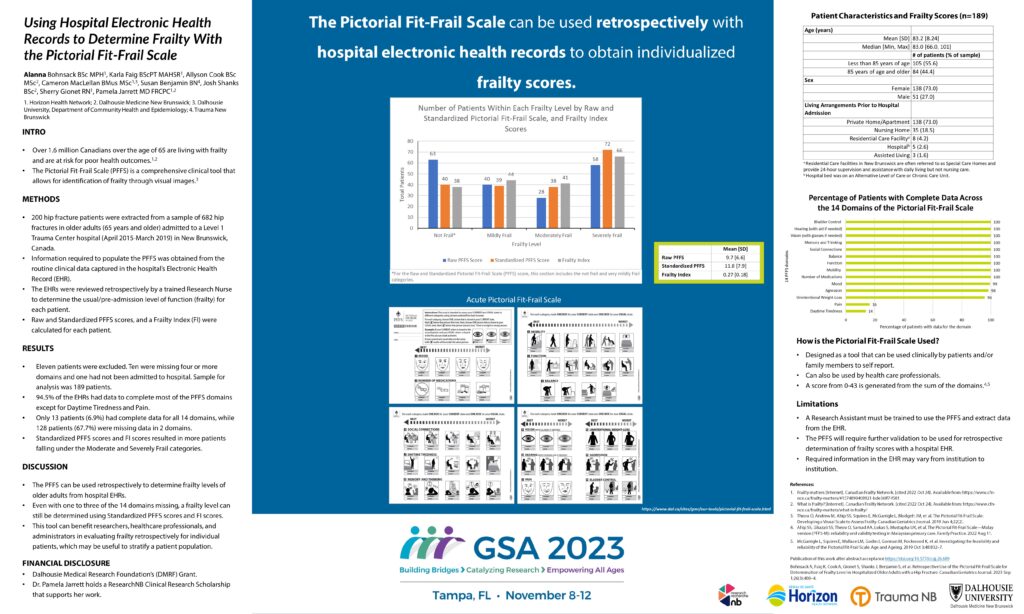
2023 GSA Annual Scientific Meeting Poster
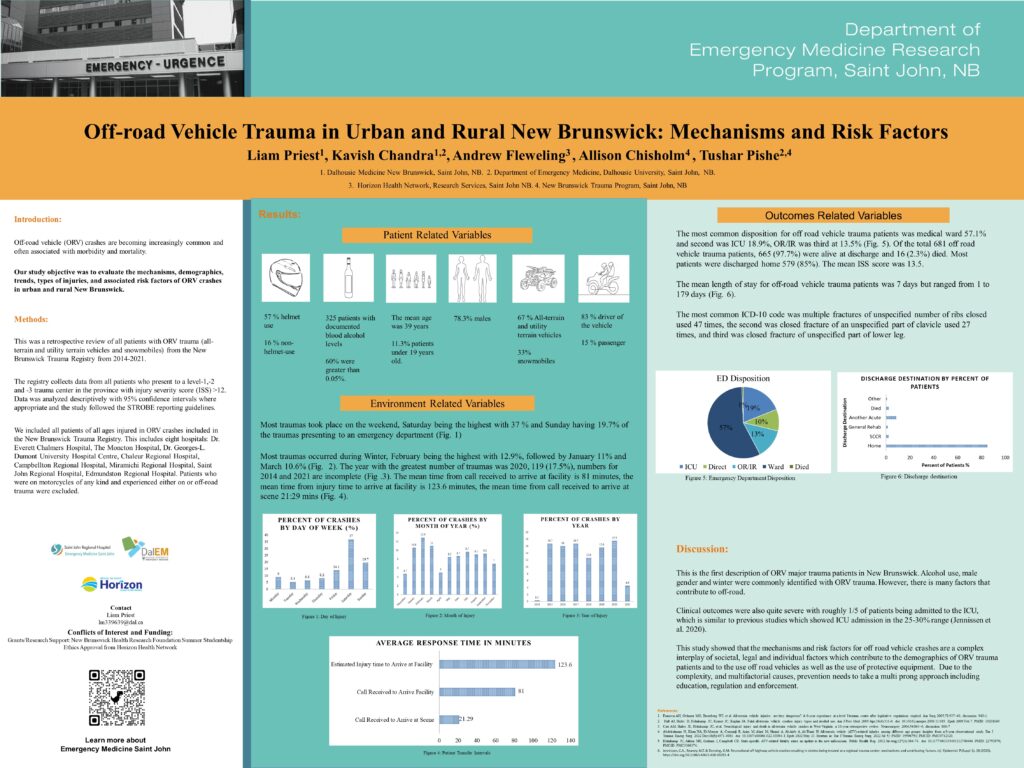
2023 TAC Conference Poster
2023 - 2025
Priest L, Flewelling A, Atkinson P, et al. (March 13, 2025) A Multi-year Review of Major Off-Road Vehicle Injuries and Deaths in New Brunswick.
MacLellan, C., Faig, K., Cooper, L., Benjamin, S. ., Shanks, J. ., Flewelling, A. J., Dutton, D. J., McGibbon, C., Bohnsack, A., Wagg, J., & Jarrett, P. (2024). Health Outcomes of Older Adults after a Hospitalization for a Hip Fracture
Bohnsack, A., Faig, K. ., Cook, A., Gionet, S., Shanks, J., Benjamin, S., Steeves, A. ., MacLellan, C., Flewelling, A. ., McGibbon, C., & Jarrett, P. (2023). Retrospective Use of the Pictorial Fit-Frail Scale for Determination of Frailty Level in Hospitalized Older Adults with a Hip Fracture.
2020 - 2021
Chisholm A., Ouelett L., Pishe T., Ringuette J., Watson I. (2021). Are early specialist consultations helpful predictors of those who require care in level 1 or 2 designated trauma centres? TAC. (Award-winning oral abstract)
Benjamin S., McEachern S., Watson I. (2021). Was the introduction of a provincially standardized consensus statement for postintubation analgesia and sedation associated with increased use of associated pharmacological therapies in New Brunswick? TAC. (Award-winning poster abstract)
Benjamin S., Watson I. (2021). Are there important variations in the care of adult trauma patients with isolated, nonoperative subdural hematomas between those admitted to a neurosurgical centre and those admitted to a non-neurosurgical centre for their entire inpatient stay? TAC.
Benjamin S., Chisholm A., Ouelett L., Totton L., Vautour J., Watson I. (2021). Is the use of business intelligence software helpful in planning injury prevention campaigns? TAC.
McEachern S., Ringuette J., Watson I. (2021). Exposure to endotracheal intubation among trauma patients in level 5 trauma centres in New Brunswick — a retrospective review. TAC.
Hickling A., Mallory K.D., Wilson K.E. et al. (2020). The youth concussion awareness network (You-CAN) – a school-based peer-led intervention to improve concussion reporting and social support: the protocol for a cluster randomized trial. BMC Public Health 20, 186.
2019
Benjamin S., Chisholm A., Watson I. (2019). Field trauma triage in New Brunswick: Understanding the “Immediate Life Threat” population TAC
Benjamin S., Chisholm A., Watson, I. (2019). What are the characteristics of field trauma triage “Bypass Failures” in an integrated, inclusive provincial trauma system? TAC
Hanlon R., French J., Atkinson P., Fraser J., Benjamin S., Poon (2019). Designing team success – an engineering solution to avoid chest tube equipment chaos using best available evidence, consensus and prototyping. Abstract Journal Canadian Journal of Emergency Medicine; 21(S1):S52
Hanlon R., French J., Atkinson P., Fraser J., Benjamin S., Poon (2019). Designing team success – an engineering approach to capture team procedural steps to develop microskills for interprofessional skills education: Abstract Journal Canadian Journal of Emergency Medicine; 21(S1):S85-86
2018
French J., Maclean D., Fraser J., Benjamin S., Atkinson P. (2018). P050: How aware is safe enough? Situational awareness is higher in safer teams doing simulated emergency airway cases. Can J Emerg Med, 20(S1), S74-S74.
French J., Maclean D., David K., McCoy A., Benjamin S., Fraser J., Pishe T., Atkinson P. (2018). P049: Changes in situational awareness of emergency teams in simulated trauma cases using an RSI checklist. Can J Emerg Med, 20(S1), S74-S74.
French J., David K., Benjamin S., Fraser J., Mekwan J., Atkinson P. (2018)MP19: Interprofessional airway microskill checklists facilitate the deliberate practice of direct intubation with a bougie and airway manikins. Can J Emerg Med, 20(S1), S47-S47.
French J., David K., Benjamin S., Fraser J., Mekwan J., Atkinson P. (2018). Interprofessional airway microskill checklists facilitate the deliberate practice of surgical cricothyrotomy with 3-D printed surgical airway trainers. Can J Emerg Med, 20(S1), S73-S74.
Hayre J., Rouse C., French J., Fraser J., Watson I., Benjamin S., Chisholm A., Stoica G., Sealy B., Erdogan M., Green R., Atkinson P. (2018).A traumatic tale of two cities: A comparison of outcomes for adults with major trauma who present to differing trauma centres in neighbouring Canadian provinces. Can J Em Med 20(2); 191-199.
Watson I., Benjamin S., Chisholm A., Ellis K., Pishe T. (2018). Rollover motor vehicle crashes in New Brunswick: A descriptive study. Can J Surg 61 (2 Supp 1) S9.
Watson I., Ellis K., Chisholm A., Pishe T. (2018). Does the presence of CT scanning in level V centres delay access to defintive care? A retrospective review from New Brunswick’s inclusive trauma system. Can J Surg 61 (2 Supp 1) S9.
Benjamin S., Watson I., Chisholm A., Pishe T. (2018). An evaluation of overtriage in New Brunswick’s field trauma triage system. Can J Surg 61 (2 Supp 1) S9.
Benjamin S., Watson I., Chisholm A., Pishe T. (2018). Major trauma and field trauma triage in New Brunswick. Can J Surg 61 (2 Supp 1) S10.
Benjamin S., Atkinson P., Fraser J., French J. (2018). How aware is safe enough? Situational awareness is higher in safer teams doing simulated emergency airway cases CJEM; 20(Supp1):S74
Robinson B., Ellis K., Holland M., Chisholm A., Watson I. (2018). Building a model for assessing trauma-related mortality in a rural trauma system. Can J Surg 61 (2 Supp 1) S10.
Rouse C., Hayre J., French J., Fraser J., Watson I., Benjamin S., Chisholm A., Sealy B., Erdogan M., Green R.S., Stoica G., Atkinson P. (2018). A traumatic tale of two cities: does EMS level of care and transportation model affect survival in patients with trauma at level 1 trauma centres in two neighbouring Canadian provinces?” Emerg Med J., 35(2): 83 – 88.
Archive
2017
2016/2017 TPRF Award Winner – Dr. Neil Branch, Dr. Pamela Jarrett, Dr. James Wagg, Dr. Tushar Pishe, Ian Watson, Sue Benjamin, Dr. Linda Yetman, Dr. Bryn Robinson, Dr. Dan Crouse, Dr. Chris McGibbon & Allison Chisholm for the study: Outcomes in Older Adults with Isolated Hip Fractures: A Comprehensive Study across Regional Hospitals in New Brunswick
Benjamin S., Chisholm A., Watson I., Pishe T. (2017). Understanding clinical hip fracture variation in New Brunswick. Can J Surg 60 (3 Supp 2) S23.
Louis R., Benjamin S., Chisholm A., Pishe T., Watson I. (2017). Concussion and admission diagnosis among seniors who fall: A descriptive analysis. Can J Surg 60 (3 Supp 2) S32.
2016
2015/2016 TPRF Award Winner – Dr. James French, Jacqueline Fraser & Devon McLean for the study: Does the use of an RSI checklist and equipment silhouette in simulated emergency scenarios improve team performance and operational safety?
McLean D., French J., Fraser J., Benjamin S., Atkinson P. (2016). Does the use of an RSI checklist and equipment silhouette in simulated emergency scenarios improve team performance and operational safety? Can J Surg 59 (3 Supp 1) S18.
Benjamin S., Hogan A., Watson I., French J. (2016). Exposure to major trauma patients and safety-critical procedures. Part 1: Risk and reliability. Can J Surg 59 (3 Supp 1) S18.
Orchard J., Cormier C., Chisholm A., French J., Pishe T., Watson I. (2016). Impact of a pre-alert program for air ambulance response to major trauma patients in a provincial, inclusive trauma program: The New Brunswick experience. Can J Surg 59 (3 Supp 1) S19.
Woodford S., Hogan A., Watson I. (2016). Impact of the repeated offering of the Rural Trauma Team Development Course (RTTDC) on trauma transfer intervals in a provincial, inclusive system. Can J Surg 59 (3 Supp 1) S19.
Kenney M., French J., Fraser J., Phlean of Emer B., Watson I., Benjamin S., Chisholm A., Atkinson A. (2016). Out in the sticks and stones may break your bones, but does rurality surely hurt you? Trauma patient health equality in New Brunswick. Can J Surg 59 (3 Supp 1) S19.
Benjamin S., Hogan A., Chisholm A., Watson I. (2016). The timely use of tranexamic acid in trauma. Can J Surg 59 (3 Supp 1) S20.
2015
2014/2015 TPRF Award Winner – Dr. Grant Hanigan, Dr. Gabriel Cormier, Dr. Mathieu Bélanger & Dr. Alier Marrero for the study: Validation of a novel tool, the RT2, for clinical diagnostic accuracy of falls occurrence in persons with Multiple Sclerosis
Phelan B., Fraser J., Pishe T., Middleton J., Chisholm A., Benjamin S., Watson I., Atkinson P. (2015). Severe trauma in the province of New Brunswick: A descriptive epidemiological study. Can J Em Med 17 (Supp1) s77.
Chisholm A., Benjamin S., Hogan A., Woodford S., Watson I. (2015). All in the family: Creating and implementing an inclusive provincial trauma registry. Can J Surg 58 (2 Supp 1) S18.
Hogan A., Woodford S., Watson I. (2015). Lessons learned from a provincial trauma transfer system. Can J Surg 59 (3 Supp 1) S18-S19.
Watson I., Hogan A., Woodford S., Chisholm A., Louis R., St. Pierre E. (2015). Trauma NB : 5 years later. Can J Surg 59 (3 Supp 1) S19.
Hogan A., Louis R. (2015). Provincial coordination of injury prevention: The New Brunswick experience. Can J Surg 59 (3 Supp 1) S19.
Hogan A., Woodford S., Watson I. (2015). Improving access and uptake of Trauma Nursing Core Course (TNCC): A provincial approach. Can J Surg 59 (3 Supp 1) S19.
Hewitson L., Atkinson P., Mekwan J., Verbeul G., Lewis D. (2015). ULTRASIM : Ultrasound in trauma simulation. Does the use of ultrasound during simulated scenarios imrpive diagnostic abilities ? Can J Surg 59 (3 Supp 1) S19-S20.
Rouse C., Hayre J., French J., Watson I., Benjamin S., Fraser J., Chisholm A., Sealy B., Erdogan M., Green R., Atkinson R. (2015). Traumatic tale of 2 cities part I: Does being treated by different EMS affect outcomes in trauma patients destined for transport to level I centres in Halifax and Saint John? Can J Surg 59 (3 Supp 1) S20.
Rouse C., Hayre J., French J., Watson I., Benjamin S., Fraser J., Chisholm A., Sealy B., Erdogan M., Green R., Atkinson R. (2015). Traumatic tale of 2 cities part II: Does being treated by different hospitals affect outcome in trauma patients destined for transport to level I centres in Halifax and Saint John? Can J Surg 59 (3 Supp 1) S20.
Phelan B., Fraser J., Pishe., Middeton J., Chisholm A., Benjamin S., Watson I., Atkinson P. (2015). Severe trauma in the province of New Brunswick: A descriptive epidemiological study. Can J Surg 59 (3 Supp 1) S28.
2014
2013/2014 TPRF Award Winner – Dr. Paul Atkinson & Dr. James French for the study: Tranexamic acid for the treatment of significant traumatic brain injury: an international randomized, double blind placebo controlled trial.
Atkinson P., French J., & Nice C. A. (2014). Procedural sedation and analgesia for adults in the emergency department. BMJ, 348(9), 2965-2977.
Exposure to major trauma management of learners training to become emergency physicians in New Brunswick. Can J Surg 57 (3 Supp 3) S65-S66.
Montazeri R., Wagg J., Mayich J., King H., Swan J., Fraser J., Benjamin S., Atkinson P. (2014). Distal radial fractures: Adequacy of reductions performed in the emergency department. Can J Surg 57 (3 Supp 3) S75.
Boulay R., Richard D., Savoie J-P., Goulette E., Chisholm A., Watson I. (2014). Improving effectiveness of field trauma triage activations in New Brunswick. Can J Surg 57 (3 Supp 3) S75-S76.
Benjamin S., Chisholm A., Watson I. (2014). Field trauma triage guidelines as a predictor of key emergency department time intervals. Can J Surg 57 (3 Supp 3) S76.
2013
2012/2013 TPRF Award Winner – Dr. Leanne Hewitson, Dr. Paul Atkinson, Dr. Glen Verheul & Dr. David Lewis for the study: ULTRASIM: Ultrasound in TRAuma SIMulation. Does ultrasound simulation improve diagnosis during simulated scenarios?
Hogan A. (2013). Sport related concussion care in the emergency department: What every ED nurse needs to know. Can J Em Nursing 36:2; 22-23.
Atkinson P., Fraser J., Benjamin S., Sproul E., Mehta A. (2013). Wake up: Head injury management around the clock. Can J Em Med (15 Supp 1) S22.
Hogan A. (2013). A collaborative approach to reducing injuries in New Brunswick: Acute care and injury prevention. Can J Surg 56 (2 Supp) S27.
Watson I., Boulay R., Chisholm A., Beairsto E., Goulette E., Martin M. (2013). Impact of changes to a provincial field trauma triage tool in New Brunswick. Can J Surg 56 (2 Supp) S28.
Woodford S., Benjamin S., Boulay R., Watson I. (2013). Ensuring quality of field trauma triage in New Brunswick. Can J Surg 56 (2 Supp) S28.
Hogan A., Boulay R., Watson I. (2013). Benefits of a provincial trauma transfer referral system: Beyond the numbers. Can J Surg 56 (2 Supp) S28.
Boulay R., Watson I., Savoie J., Benjamin S., Martin M. (2013). The field trauma triage landscape in New Brunswick. Can J Surg 56 (2 Supp) S28-S29.
Watson I., Hogan A., Woodford A., Benjamin S., Chisholm A., Ondiveeran H., Martin M. (2013). Impact of Rural Trauma Team Development Course (RTTDC) on trauma transfer intervals in a provincial, inclusive trauma system. Can J Surg 56 (2 Supp) S29.
Howlett M., Atkinson P., Doody K., Fraser J., Leblanc-Douchin D., Strack B. (2013). Trauma and stress: A critical dynamics study of burnout in trauma centre healthcare professionals. Can J Surg 56 (2 Supp) S29.
Atkinson P., Naveed A., vanRensburg L., Madan R. (2013). Ultrasound-guided pediatric forearm fracture reduction in the emergency department. Can J Surg 56 (2 Supp) S29.
Chesters A., Atkinson P. (2013). Block first, opiates later? The use of fascia iliaca black for patients with hip fractures in the emergency department: A systematic review. Can J Surg 56 (2 Supp) S29-S30.
Atkinson P., Fraser J., Verheul G., Parks A., Milne J. (2013). Simulation in trauma ultrasound training. Can J Surg 56 (2 Supp) S30.
Fraser J., Atkinson P., Benjamin S., Sproul E., Mehta A. (2013). Wake up: Head injury management around the clock. Can J Surg 56 (2 Supp) S31.
2012
Musgrave E. (2012). Trauma NB : A model of inclusivity. Outlook 35(1); 23-24.
Benjamin S., Hogan A. (2012). Closing the quality improvement loop: A collaborative approach. Can J Surg 55 Supp, S23.
Hogan A., Benjamin S. (2012). National Trauma Registry: “Collecting” it all in New Brunswick. Can J Surg 55 Supp, S23.
Fraser J., Atkinson P., Benjamin S. (2012). Does delay to initial shoulder reduction attempt affect success rate for anterior shoulder dislocation (pilot study)? Can J Surg 55 Supp, S23.
Martin M., Watson I, Hogan A., Benjamin S., Woodford S. (2012). Use of multidisciplinary, multi-site morbidity and mortality rounds in a provincial trauma system. Can J Surg 55 Supp, S23 –S24.